
SUMMARY
Bone cancer in dogs is most often osteosarcoma, an aggressive tumor that usually starts in the long bones of the legs in large and giant breeds. Early signs include a worsening limp and firm, painful swelling. It isn’t curable, but amputation, chemotherapy, radiation and pain management can give dogs more good-quality time.
Few conversations in my exam room are harder than this one. For a lot of owners, it starts with what looked like a simple limp and ends with the word cancer.
This article is about recognizing bone cancer early, understanding how it’s diagnosed, and walking through your options honestly, so you can make the decision that’s right for your dog and your family.
What brings these dogs in varies. Sometimes it’s limping, and sometimes it’s a big swelling around a joint. Sometimes we pick it up on a routine physical exam. I’m feeling the dog, happen to press around the elbow, and the dog yelps. I think, “Oh, that’s weird,” and then we take an X-ray and see what’s going on.
Unfortunately, by the time an owner notices something, the disease can already be quite advanced.
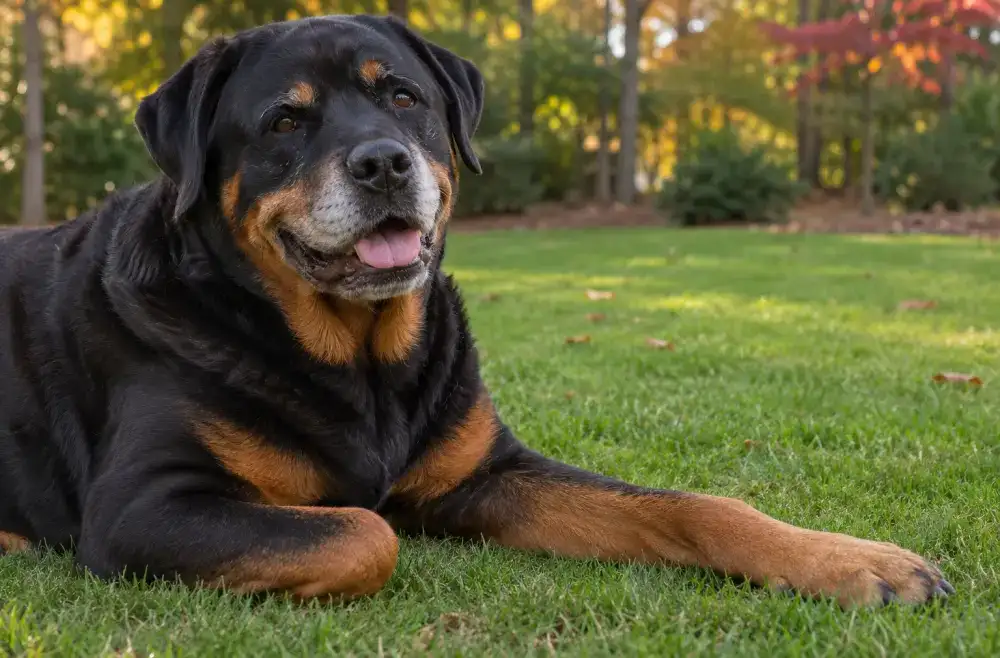
At ModernVet, the dogs I see with bone cancer as a veterinarian in Johns Creek, GA are most often our large and giant breed patients, and the early signs in those dogs can look a lot like ordinary arthritis.
What Is Bone Cancer in Dogs (Osteosarcoma)?
Bone cancer in dogs is most often osteosarcoma, the most common primary bone tumor in dogs, accounting for over 80% of bone tumors. It is an aggressive tumor, and it’s most common in large and giant breeds around 7 years old.
Table 1: Bone Cancer in Dogs – Myths vs. Facts
| Common Belief | The Reality | Why It Matters |
|---|---|---|
| “Limping in an older big dog is just arthritis.” | Osteosarcoma often shows up first as a worsening lameness or a firm limb swelling in a large or giant breed dog, and the early picture overlaps with arthritis. | A limp that keeps getting worse, or won’t respond to arthritis care, deserves an X-ray rather than wait-and-see |
| “Amputation is cruel for a big or older dog.” | Most dogs adapt remarkably well to three legs, and amputation removes the source of severe bone pain. | The decision should weigh the individual dog’s body condition, other joints and quality of life, not the assumption that three legs means suffering |
| “If we amputate, we’ve removed the cancer.” | By the time osteosarcoma is diagnosed, microscopic spread (usually to the lungs) is already present in most dogs, even when chest X-rays look clear. | Surgery controls pain at the primary site; chemotherapy is what delays the spread that ultimately limits survival |
| “Nothing can really be done, so euthanasia is the only option.” | There is a real menu of choices, from aggressive therapy to pain-focused palliative care, and each can buy good-quality time. | Owners deserve the honest range of options, not a false all-or-nothing choice |
| “Those survival numbers mean a cure.” | Median survival times describe the middle of a range, not a cure. Osteosarcoma is not curable, and individual dogs vary widely. | The goal is more good days and good pain control, framed honestly, rather than a promised cure |
Sources: Merck Veterinary Manual: Bone Tumors in Dogs and Cats. Cornell Riney Canine Health Center: Osteosarcoma in Dogs.
In plain terms, osteosarcoma is a malignant tumor of the bone. It destroys normal bone and replaces it with weak, abnormal bone. That bone destruction is why it’s so painful, and why the affected bone can eventually break.
Large and giant breed dogs are the most affected, including Rottweilers, Great Danes, Saint Bernards and Golden Retrievers, and there is likely a genetic component. Most of these bone tumors start in the long bones of the legs. Tumors in the axial skeleton (the skull, spine, ribs and pelvis) are less common and can appear in smaller dogs.
What Are the Early Signs of Bone Cancer in Dogs?
The most common early signs of bone cancer in dogs are a worsening limp with no clear injury and a firm, painful swelling over a bone, usually on a leg.
Table 2: Early Signs of Bone Cancer in Dogs
| Sign | What You Might Notice | Why It Matters |
|---|---|---|
| Persistent lameness | A limp that appears without a clear injury and gets worse over weeks, often in a front leg. | The most common first sign; easily mistaken for arthritis in an older large breed dog |
| Firm swelling over a bone | A hard, sometimes warm and painful swelling, commonly near the wrist, shoulder or knee. | Classic osteosarcoma sites are the distal radius, proximal humerus, distal femur and proximal tibia |
| Pain and behavior changes | Reluctance to walk or play, muscle loss in the affected limb, or changes in appetite or mood. | Osteosarcoma is often very painful, and pain can first show up as a change in behavior |
| Sudden non-weight-bearing lameness | The dog suddenly won’t put any weight on a leg, sometimes after minor activity. | May signal a pathologic fracture through tumor-weakened bone, which is urgent |
| A limp that doesn’t fit “just arthritis” | Lameness that worsens, stays in one limb, or doesn’t respond to typical arthritis care. | A worsening limp in a large or giant breed dog is worth an X-ray sooner rather than later |
Sources: Merck Veterinary Manual: Bone Tumors in Dogs and Cats. Cornell Riney Canine Health Center: Osteosarcoma in Dogs.
The classic picture is a persistent, worsening lameness in a front leg, often with a hard swelling near the wrist or shoulder, and sometimes muscle loss in that limb. Bone cancer isn’t the only cancer that can start quietly, and my guide to the 10 warning signs of cancer in dogs covers others worth knowing.
There’s an urgent version of this, too. A bone weakened by the tumor can break with little or no trauma. This is called a pathologic fracture, and it usually shows up as a sudden, severe, non-weight-bearing lameness. If your dog suddenly won’t put any weight on a leg or seems to be in severe pain, don’t wait for a routine visit. Reach out for urgent care in Johns Creek, GA.
When a large or giant breed dog comes in with a worsening limp, three things make me suspicious: age, location and breed. When a dog comes in with swelling or limping, and it’s an older dog, seven to ten years old, that makes my antenna pop up a little bit. There’s also a smaller secondary spike in very young dogs, around one to two years of age. That’s relatively uncommon, but it’s something we keep in mind.
Then there’s location. “Away from the elbow, toward the knee” is a well-known memory tool we use for osteosarcoma in dogs: away from the elbow in the front legs, and toward the knee in the back legs.
And then breed. If it’s a Rottweiler, Great Dane, Irish Wolfhound, Saint Bernard, Newfoundland, Mastiff or another large or giant breed, that automatically raises my suspicion.
Which Dogs Get Bone Cancer, and Why?
Bone cancer in dogs is most common in large and giant breeds, usually middle-aged to older, and tends to start in the long bones of the legs.
Size and breed are the biggest risk factors. Most dogs are around 7 at diagnosis, though a small number of young dogs, around one to two years old, are affected too.
Here’s where it gets tricky. Because the early sign is a limp, osteosarcoma is easy to mistake for arthritis, and many of these dogs are old enough to have real arthritis as well. That’s exactly why a worsening limp in an at-risk dog deserves imaging. Senior wellness exams and early lameness checks through our preventive care in Duluth, GA give us the chance to catch changes before they progress.
The tumor tends to favor the areas near the wrist, shoulder and knee. In veterinary medicine terms, those are the distal radius, proximal humerus, distal femur and proximal tibia, which is exactly what “away from the elbow, toward the knee” describes.
How Do Vets Diagnose Bone Cancer in Dogs?
Vets diagnose bone cancer by combining a physical exam, X-rays of the painful bone, a biopsy or fine needle aspirate to confirm the tumor type, and chest X-rays and bloodwork to check for spread and overall health.
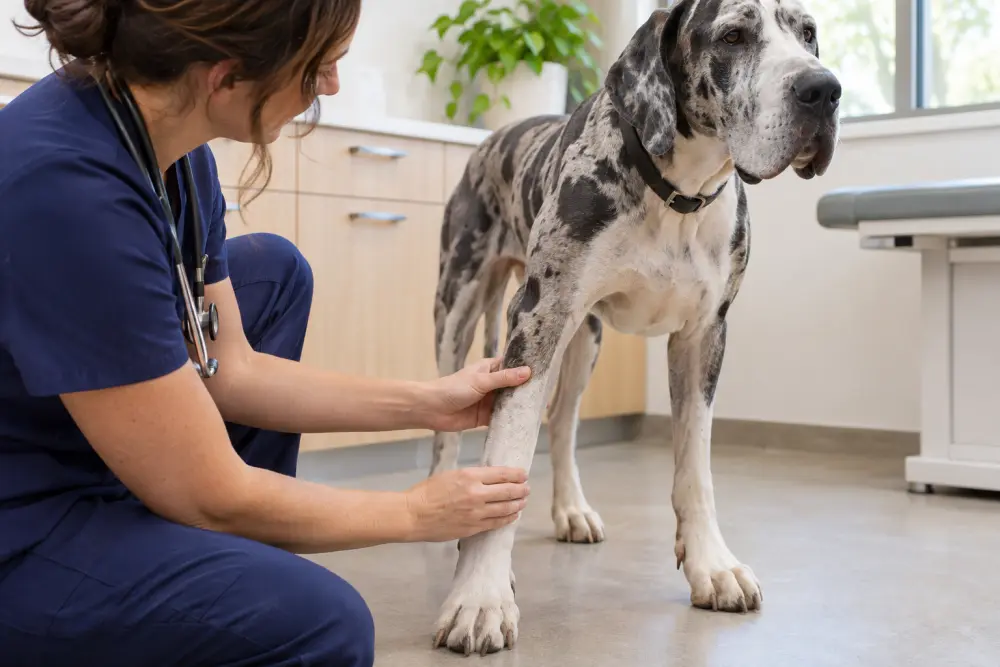
Step 1: X-Rays of the Affected Bone
X-rays (radiographs) are the first and most important step. Osteosarcoma often produces a characteristic mix of bone destruction and abnormal new bone growth. That appearance is suggestive, but it isn’t proof on its own.
A lot of times, we ask that a radiologist get involved, because especially early in the disease, arthritis and bone cancer can look similar. Having a specialized radiologist look at the X-rays helps us catch things early.
Step 2: Fine Needle Aspirate or Biopsy
To confirm the tumor type, we can sample cells with a fine needle aspirate (FNA) or take tissue with a biopsy of the affected bone. Only a biopsy confirms osteosarcoma definitively, but an aspirate can strongly support the suspicion.
A bone biopsy may be the next step. But to be honest, a lot of the cases we catch are already advanced, and by then we’re often having conversations about next steps.
Step 3: Staging and Overall Health
We also check the chest when we do these X-rays, because the lungs are a common place for osteosarcoma to spread. Blood tests and a urinalysis tell me about your dog’s overall health, and a high serum alkaline phosphatase (ALP) is a negative prognostic sign.
If we see a suspected bone tumor in a leg and then see that it has spread to the lungs, that worsens the prognosis and changes the conversation about treatment. Even when chest X-rays look clear, microscopic spread is usually already present in most dogs at diagnosis. So staging isn’t just about the leg. It’s about understanding the whole picture. Regular preventive care in Johns Creek, GA gives me a baseline to compare against.
Depending on where the tumor is and what we find, we may suggest surgery here or refer to a board-certified surgeon. We’re often able to help with the surgical side here at the practice as well.
What Are the Treatment Options for Bone Cancer in Dogs?
Treatment for bone cancer in dogs usually combines controlling the primary tumor (amputation, limb-sparing surgery or radiation), chemotherapy to delay spread, and pain management, with the goal of more good-quality time rather than a cure.
Table 3: Treatment & Comfort Options for Bone Cancer in Dogs
| Option | What It Involves | What to Expect |
|---|---|---|
| Amputation | Surgical removal of the affected limb to eliminate the painful primary tumor. | Most dogs adapt very well to three legs; it removes the pain but does not stop spread. Median survival is roughly 4 to 6 months with amputation alone |
| Amputation + chemotherapy | Amputation followed by IV chemotherapy (commonly carboplatin, sometimes doxorubicin or cisplatin), usually about every 3 weeks for several rounds. | The standard for extending good-quality time; it delays lung spread. Median survival is roughly 9 to 12 months, and most dogs tolerate chemotherapy well |
| Limb-sparing surgery | A specialist procedure that removes the tumor while preserving the leg, best suited to certain sites such as the distal radius. | An option when amputation isn’t ideal; not every dog is a candidate, and implant infection or failure are possible complications |
| Radiation therapy | Palliative radiation (PRT) for pain relief when surgery isn’t pursued, or stereotactic radiation (SRT) as a precise, surgery-sparing specialist option. | Palliative radiation focuses on comfort; stereotactic radiation can target the tumor more precisely in selected cases |
| Pain management & comfort care | NSAIDs, gabapentin, amantadine and opioids, often combined, plus IV bisphosphonates to help with bone pain. | The foundation of every plan, and a valid path on its own when owners choose comfort-focused care. Pain control guides quality-of-life and timing decisions |
Sources: Merck Veterinary Manual: Bone Tumors in Dogs and Cats. Cornell Riney Canine Health Center: Osteosarcoma in Dogs.
Amputation
Amputation removes the painful primary tumor, and most dogs adapt remarkably well to three legs. On its own, though, amputation doesn’t stop the spread, and median survival time is roughly 4 to 6 months.
Amputation Plus Chemotherapy
Amputation followed by chemotherapy is the standard for extending good-quality time. Carboplatin is the most common choice, usually given about every 3 weeks for several rounds. Median survival is roughly 9 to 12 months, and most dogs tolerate chemotherapy well.
Limb-Sparing Surgery and Radiation Therapy
Limb-sparing surgery is a specialist surgical procedure that removes the tumor while preserving the leg. It works best at certain sites, like the distal radius, and not every dog is a candidate.
Radiation therapy comes in two main forms. Palliative radiation therapy focuses on pain relief when surgery isn’t pursued. Stereotactic radiation is a precise, specialist option that can treat the tumor locally in selected cases.
Pain Management and Comfort Care
Pain management is part of every plan, whatever path you choose. That often means combining oral medications like NSAIDs, gabapentin and amantadine, sometimes opioids, along with IV bisphosphonates to help with bone pain. Comfort-focused care is also a valid path on its own. For more on how we keep dogs comfortable, see my guide to safe pain relief options for dogs.
I want to be honest about what the numbers mean. Survival times are medians across many dogs, not guarantees, and osteosarcoma is not curable. The aim is comfort and good days.
When I talk owners through these options, it’s really dog dependent. If this is a young dog that’s otherwise healthy and there are no signs of spread, then absolutely, we can talk about going down that diagnostic and treatment pathway. But we also have to look at what other conditions they have, their quality of life outside of the cancer, and their overall health. It’s a big picture. Finances become involved, too, along with the owner’s personal preferences. Some people feel strongly about chemotherapy or palliative care.
We talk through the pros and cons of each option, because each one has advantages and disadvantages. There isn’t a perfect selection for every single dog, and there isn’t a one-size-fits-all treatment plan for osteosarcoma. The goal is to make sure everybody understands the options and is on the same page.
Having an Honest Conversation About Options (Quality of Life & Timing)
Choosing care for a dog with bone cancer means weighing quality of life, pain control, and what’s right for your family, and there is no single correct answer.
Aggressive treatment and comfort-focused palliative care are both legitimate, loving choices. Choosing comfort care isn’t giving up, and choosing amputation and chemotherapy isn’t putting your dog through too much. The right path depends on the dog, the family and the circumstances.
That’s why I think having a relationship with your veterinarian is so important. You need to be able to have open, honest, raw and, quite honestly, difficult conversations about your pet’s mortality. That’s hard, and it becomes easier when you have that relationship. Every case is unique. Every patient is different, and every owner is different.
Quality of Life Comes First
Quality of life is paramount here. You can have minimal disease and still have a terrible quality of life. Quality of life is the most important tool in assessing where we go from here, and everybody has a different perspective on what that means.
Good pain control is the foundation of any plan. Watching for more bad days than good days is one of the clearest ways for owners and vets to judge how things are going. Regular rechecks let us adjust pain medications as things change, and our Wellness Plans in Suwanee, GA make that ongoing monitoring easier to keep up with.
You Don’t Have to Decide Today
Many owners worry about making a decision too soon or too late. This is a decision we make together, guided by your dog’s comfort, and it shouldn’t be rushed.
When I diagnose osteosarcoma and we’re considering amputation, I want people to have time to think. I’ll often tell them, “Listen, go home. Speak to your family. Sleep on it for a night, and let’s talk tomorrow.” I don’t want owners to feel that they have to make a decision right then and there in the exam room or on that phone call.
These are big decisions. I want owners to have the time to think about them and feel supported.
Frequently Asked Questions
Is bone cancer in dogs curable?
No, osteosarcoma is not curable, but it is treatable. Treatment aims to give your dog more good-quality time and good pain control, not a cure. Individual dogs vary widely, which is why I build every plan around comfort and protecting the good days rather than promising an outcome.
How long do dogs live with bone cancer?
It depends on the path you choose and on the individual dog. As rough median ranges, untreated dogs live about 1 to 2 months, dogs treated with amputation alone about 4 to 6 months, and dogs treated with amputation plus chemotherapy about 9 to 12 months. These are ranges, not guarantees.
Will my dog be okay on three legs?
For most dogs, yes. Dogs adapt remarkably well to three legs, and amputation removes a major source of pain. Before recommending it, I look closely at your dog’s body condition, weight and other joints, including any severe arthritis, because those all affect how well a dog adjusts.
Is bone cancer painful for dogs?
Yes, it is often very painful, because the tumor destroys normal bone and replaces it with weak, abnormal bone. That’s why pain control is central to every plan, including comfort-focused care. Combined pain relievers, IV bisphosphonates and palliative radiation can all help keep a dog comfortable.
What if I don’t want to pursue surgery or chemo?
That is a real option, and it isn’t giving up. Comfort-focused palliative care means managing pain with oral medications, sometimes adding palliative radiation, and checking in on quality of life regularly. My job is to help keep your dog comfortable and to support whatever path your family chooses.
Conclusion: Supporting Your Dog Through Bone Cancer
Bone cancer in dogs is most often osteosarcoma, an aggressive but treatable tumor. The keys are catching a worsening limp early, confirming the diagnosis, understanding the honest range of options, and keeping your dog comfortable throughout.
If your large or giant breed dog has a limp that keeps getting worse, a firm swelling on a leg, or pain that doesn’t fit “just arthritis,” please schedule a veterinary appointment in Johns Creek, GA. For dogs already living with a diagnosis, our Wellness Plans in Alpharetta, GA make ongoing rechecks and pain-management support easier.
Whatever you decide, you won’t be making that decision alone. With bone cancer in dogs, quality of life is paramount. I want every family to have time to go home, talk it over, sleep on it, and feel supported in the choice they make.