
SUMMARY
Despite the name, ringworm in cats isn’t caused by a worm, but rather a fairly common fungal infection of the skin, hair, and nails. It’s contagious to other pets and humans alike, and spreads through direct contact and contaminated environments. Our guide will help you understand what ringworm really is, how it spreads, and how vets diagnose and treat it.
Ringworm in cats is often the last thing owners are expecting, and the name doesn’t help. There’s no worm involved at all. Ringworm is a fungus, and that one misunderstanding can send owners looking for the wrong treatment for their cat.
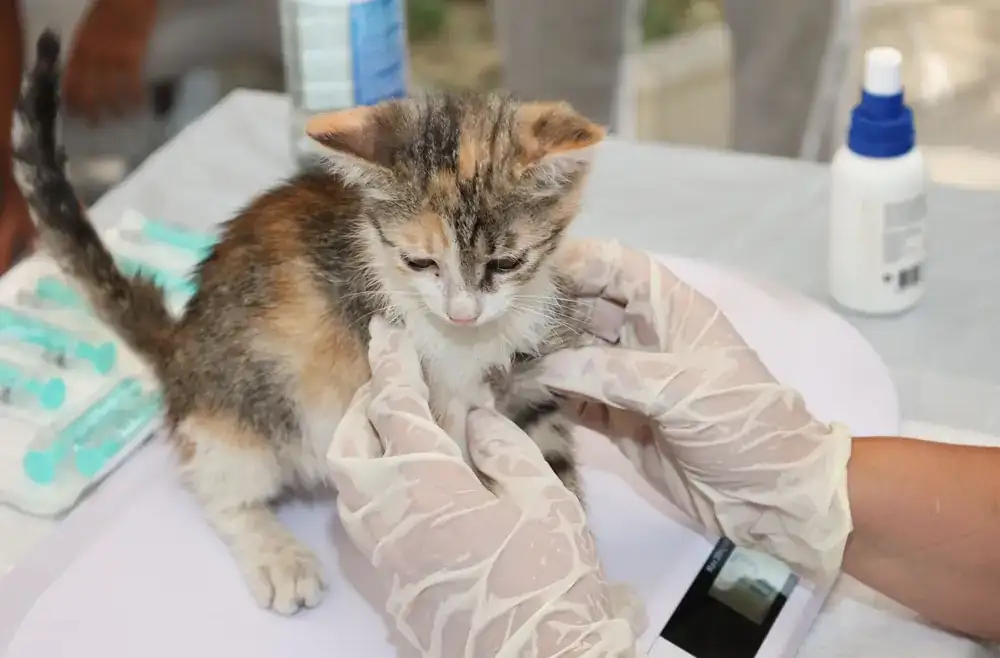
At ModernVet, where I practice as a Veterinarian in Johns Creek, GA, we see it fairly often, especially in young kittens. It’s often the last thing people are expecting. A lot of people don’t even know that dogs and cats can get ringworm. We often see kittens that people have found outside or taken in off the streets, and they come in with ringworm.
What Is Ringworm in Cats, and Why Isn’t It a Worm?
Ringworm in cats, also known as feline dermatophytosis, is a fungal infection of the skin, hair, and nails, most commonly caused by the fungus Microsporum canis. While the name might suggest different, worms are not involved whatsoever.
Here are some other common misunderstandings associated with ringworm.
Table 1: Ringworm in Cats – Myths vs. Facts
| Common Belief | The Reality | Why It Matters |
|---|---|---|
| “Ringworm is a worm.” | It’s a fungal infection (feline dermatophytosis) — no worm involved. The name comes from the ring-shaped skin lesion it can create. | Changes treatment entirely: antifungals, not dewormers |
| “FeLV/FIV cats get it because they’re immunocompromised.” | Current evidence shows feline leukemia virus and feline immunodeficiency virus status does not predispose an otherwise healthy cat to ringworm. | The real predisposing factors are young age and crowded settings — not a weak immune system |
| “If the Wood’s lamp doesn’t glow, it’s not ringworm.” | Used correctly, 91–100% of untreated M. canis infections fluoresce apple-green — but false negatives and false positives both happen. | The Wood’s lamp is a screening tool, not a standalone diagnosis |
| “It’ll just clear up on its own.” | Many healthy cats do self-cure over weeks to months — but they keep shedding fungal spores and stay contagious the whole time. | Treatment shortens the course and protects other pets and people |
| “Only the bald patch is infected.” | Spores contaminate the cat’s whole coat and the environment around it, not just the visible lesion. | Environmental decontamination is part of the cure, not an optional extra |
Sources: Moriello KA, Coyner K, Paterson S, Mignon B (2017) Vet Dermatol 28(3):266-e68: Diagnosis and treatment of dermatophytosis in dogs and cats (WAVD guidelines). Merck Veterinary Manual: Dermatophytosis in Dogs and Cats.
The fungus feeds on keratin in the cat’s skin, hair shafts, and nails, often creating a circular skin lesion with a red edge, hence the “ring” in “ringworm”.
What Are the Signs of Ringworm in Cats?
There are several common and recognizable signs of ringworm in cats, including patchy hair loss, broken hairs, and crusty or scaly skin lesions, most often on the face, ears, and paws.
But it varies considerably. It can be very mild, or it can be extremely severe. It can look like just a little bit of hair loss, scaling, or crusting. Sometimes there are comedones or hyperpigmentation of the skin. Sometimes they’re itchy, and sometimes they’re not. It really depends on the cat.
Sometimes it’s one single spot; sometimes it’s multiple spots. It could be symmetrical or asymmetrical. It can look so different, and that’s what makes it hard to say right off the bat, “Oh yeah, that’s ringworm.”
Sometimes you see that classic ring, but oftentimes it’s just patchy or scaly. It can look a lot of different ways.
Some cats show miliary dermatitis, which looks like tiny crusty bumps across the skin, and occasionally the entire cat is affected.
That’s what can make identifying ringworm in cats so tricky for owners. Oftentimes, kittens and long-haired cats can be infected with very few signs, and they can spread the fungus for a while without being detected.
If you notice spreading lesions, have your cat seen promptly. For a very young kitten that’s lethargic or not eating, or a skin infection that’s getting worse quickly, our Urgent Care in Johns Creek, GA is here for you.
How Does Ringworm Spread?
Ringworm is contagious and spreads through direct contact with infected animals, as well as infected environmental contamination, as fungal spores can survive in the open for months.
Here’s a breakdown of the most common ways ringworm in cats can spread to others, including animals and humans.
Table 2: How Ringworm Spreads in Cats (Transmission & Risk Factors)
| Route / Factor | How It Works | Notes |
|---|---|---|
| Direct contact | Contact with an infected cat or other infected animals (including dogs and cats in the home), or with an infected pet’s bedding and people | The most common route; transmission occurs through infected hairs and spores |
| Contaminated environment / fomites | Fungal spores survive for months on bedding, grooming tools, clippers, carpets and furniture | Environmental contamination matters — microtrauma to the skin (e.g., clipping) helps spores establish infection |
| Infected hairs & spores | Broken, infected hairs shed spores that remain infective in the environment long after they fall out | Reducing environmental contamination is central to stopping spread |
| Predisposing factors | Young kittens, Persian cats, and cats in shelter, foster care or multi-cat/overcrowded homes are most affected | Young animals and crowding — not FeLV/FIV — are the true predisposing factors |
| Zoonotic (spread to people) | Ringworm passes readily between cats and humans; children and immunocompromised people are more susceptible | Basic hygiene when handling infected animals prevents most human cases |
Sources: Merck Veterinary Manual: Dermatophytosis in Dogs and Cats. Moriello KA et al. (2017) Vet Dermatol: WAVD guidelines.
While direct contact is the most obvious method of spreading, the environmental aspect can’t be overlooked, as infected hairs shed fungal spores that remain infective and can live on bedding, brushes, and carpet for months on end.
If spores are still in the home, a treated cat can be reinfected. That’s why I urge owners to clean the home thoroughly, not just treat the cat.
While there are cats that are inherently predisposed to ringworm infection, that does not, as many think, include cats with feline leukemia virus or feline immunodeficiency virus, as those conditions do not on their own increase the risk of ringworm. The most naturally predisposed cats are young kittens, Persian cats, shelter cats, or cats in foster or multi-cat settings.
Is Ringworm in Cats Contagious to People and Other Pets?
Yes, ringworm is zoonotic, which means it can spread between cats, other pets, and humans.
- For Other Pets: Ringworm can easily spread to dogs and other cats, so any animals that have been in contact with infected cats should be checked and, if necessary, treated.
- For People: In humans, ringworm usually causes mild, treatable circular skin lesions. Children and immunocompromised individuals are most at-risk. When handling infected animals, be sure to take basic hygiene precautions like wearing gloves and regular handwashing.
Remember, most ringworm cases are mild and treatable, so it’s usually not a cause for panic. But because of its contagious nature, you should still act quickly to contain it. Get the proper treatment for your pet and take steps to stop the spread to avoid reinfection.
How Do Vets Diagnose Ringworm in Cats?
No single test can definitively diagnose ringworm on its own, so we typically rely on a combination of several tools and methods, including a Wood’s lamp exam, direct microscopic examination of hairs, fungal culture, and PCR testing.
- Wood’s Lamp: A UV light engineered to make many M. canis-infected hairs glow bright green. It’s a quick, easy way to get an idea of what we’re looking at, but is not itself proof of ringworm.
- Direct Microscopic Examination: We’ll place plucked infected hairs under a microscope to look for fungal growth on the hair shafts.
- Fungal Culture: We’ll take some hair or skin samples and see if the fungus grows. This has long been considered the most reliable reference test. Results can take days or weeks.
- PCR Testing: This testing quickly detects fungal DNA, but sometimes has trouble differentiating live spores and dead cells, making it more useful when paired with a culture.
- Skin Biopsy: Rarely used outside of unusual cases (i.e. nodular lesions on Persian cats) or when we need to rule out other diseases.
The best approach I’ve found is using these tools together with a fungal culture. We use sterile instruments to collect material from the affected skin and lesions, then try to grow the fungus on a medium that allows for ringworm growth.
Typically, we use a combination of these things, but we most heavily rely on fungal culture and PCR. That’s how we try to make sure we’re not missing anything.
Screening new kittens and cats coming from multi-cat environments, along with routine skin checks, can help catch ringworm before it becomes a major issue. That’s one reason I stress Preventive Care in Duluth, GA and regular check-ups for every cat.
How Do Vets Actually Treat Ringworm in Cats?
Ringworm in cats is best treated by combining topical therapy, systemic medication, and environmental decontamination, all of which need to be continued until we confirm the patient is cured, not just when they’re looking better.
Here’s a breakdown of the most common treatment processes.
Table 3: How Vets Actually Treat Ringworm in Cats
| Treatment Component | What It Involves | Notes |
|---|---|---|
| Topical therapy | Whole-body antifungal rinses/dips — most commonly lime sulfur dip or enilconazole — usually twice weekly | Treats the coat and cuts spore shedding; lime sulfur smells of rotten eggs but is highly effective and safe, even for young kittens. Localized lesions in an otherwise healthy cat may be treated topically |
| Systemic (oral) medication | Oral antifungals — typically itraconazole or terbinafine — often on a week-on / week-off schedule | The standard for most true infections; treatment runs several weeks. Monitor for adverse reactions |
| Combination therapy | Topical + systemic medication together is the standard of care for most infected cats | Resolves infection faster and reduces environmental contamination more than either approach alone |
| Environmental decontamination | Mechanical cleaning (vacuum, launder, wipe) followed by disinfection; a dilute bleach solution (chlorine bleach) on suitable surfaces helps kill spores | Removes infective spores from the home; repeat regularly throughout treatment |
| Confirming cure | Treat to clinical cure PLUS mycological cure — traditionally consecutive negative fungal cultures (PCR increasingly used alongside) | Don’t stop at “looks better” — a cat can still be shedding spores after the lesions heal |
Sources: Moriello KA et al. (2017) Vet Dermatol 28(3):266-e68: WAVD guidelines. Merck Veterinary Manual: Dermatophytosis in Dogs and Cats.
Treatment is important because this is an infectious disease. It’s contagious to other animals, and it’s zoonotic, meaning it can spread to people as well.
Historically, topical therapy meant lime sulfur dips. They’re effective, but they smell like rotten eggs, cats don’t like baths, and those dips can be stressful, so that’s not typically what I recommend in our practice. Instead, we have owners use a medicated miconazole and chlorhexidine shampoo twice a week.
We also use systemic antifungal therapy at the same time, usually itraconazole, to address the infection within the hair follicle. Treatment runs for several weeks, and I ask owners to watch for any side effects and call us if anything comes up.
A combination of these methods is common and effective, as it works faster and reduces the risk of environmental contamination.
We try to quarantine affected cats from other animals to prevent spread. This can be a big problem in catteries and rescue organizations. A big part of treatment is also environmental decontamination: using disinfectants, washing fabrics, vacuuming rugs, and cleaning pet food bowls.
A cat can look and feel healed while still shedding infective spores, so it’s important to be consistent in treatment until we’re certain they’re cured. Typically, we look for consecutive negative fungal cultures to be sure.
Keeping owners on track can be tough. We check in with them and give them phone calls. We’re always there as a resource and a guiding light for our pet owners, so they can call anytime with questions. We typically try to check in once a week to make sure they’re not having any issues.
How Do You Clean Your Home After Ringworm?
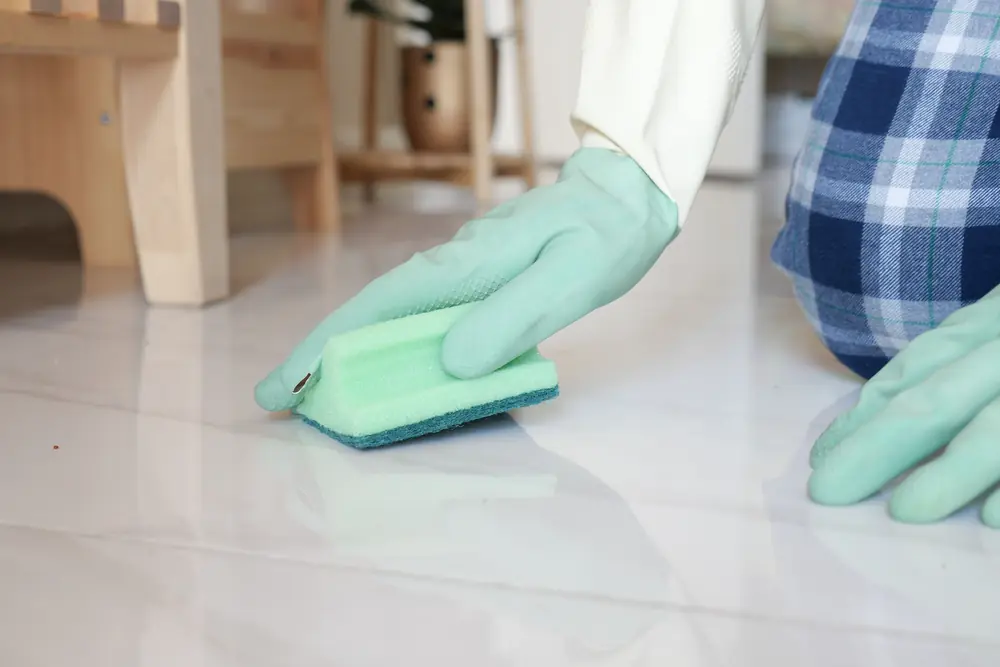
Cleaning a home after dealing with ringworm in cats is so important, because infective spores can survive in the environment for several months, so you should be sure to physically remove infected hairs and disinfect any areas in your home where your infected cat may have had contact.
Common household cleaning methods like vacuuming, wiping surfaces, and washing bedding are a great start. Then, it’s time to disinfect with a suitable product. A dilute bleach solution (chlorine bleach) is very effective in killing spores on hard surfaces where appropriate.
A lot of this overlaps with treatment: keeping the affected cat separated from other animals and staying on top of environmental cleaning. For people in the household, wear gloves, wash your hands, and practice basic hygiene. If you see any lesions on yourself, please contact your doctor.
Any other cats or dogs in the home should be checked as well, and treated if needed. We can take care of that as part of our Preventive Care in Buford, GA.
Frequently Asked Questions
Is ringworm in cats an emergency?
No, most cases of ringworm in cats are mild and easily treatable. But ringworm is very contagious and should be treated as quickly as possible to mitigate the spread of the infection, especially since infective spores can live out in the open for several months. I would also point out that we see it most often in kittens, and because they are more susceptible to infections, they should be treated right away.
How long is a cat with ringworm contagious?
A cat with ringworm should be considered contagious until they’re confirmed cured, not just until the lesions heal. Cats can keep shedding infective spores while their skin looks better, which is why we treat until we get consecutive negative fungal cultures before calling it done.
Can I catch ringworm from my cat?
Absolutely. Ringworm is zoonotic, which means it can spread to other species of animals as well as humans. While it’s unpleasant and can cause lesions on the skin, ringworm in humans is usually mild and very treatable. Still, you’d rather avoid it, so be sure to take basic hygiene precautions like wearing gloves and regularly washing hands while handling infected pets.
Will ringworm go away on its own?
In many cats, yes. The ringworm fungus may go away in a healthy cat over the course of weeks or months. However, the cat and its environment remain contagious as long as infective spores on hairs remain present, so I highly recommend treatment to nip that in the bud and try to keep other pets or people from getting infected.
How do I clean my house so my cat doesn’t get reinfected?
Routine household cleaning methods like vacuuming and washing bedding are a great start in getting rid of infective spores that can reinfect a cat, even if it’s fully cured. Then, take steps to disinfect any areas where the cat was present. A dilute bleach solution works great. Just make sure to check if it’s appropriate for your surface before using it.
Conclusion
Ringworm isn’t a worm at all, but rather a fungal infection that is common and very treatable. The best plan to combat ringworm in cats is knowing the signs, recognizing them early, treating the patient, protecting the rest of the household from infection, cleaning and disinfecting the environment to mitigate the risk of reinfection, and confirming the patient is truly cured (not just appearing to be cured) before stopping treatment.
Ringworm in cats is contagious to other animals and humans alike, and it can spread easily through direct contact with an infected feline or environment. But with the right know-how and quick action, you can deal with ringworm swiftly and effectively, treating your cat and protecting yourself, your loved ones, and other animals.
Here at ModernVet, we have plenty of experience treating ringworm in cats, and our Wellness Plans in Suwanee, GA include follow-up rechecks to make sure your cat is truly cured, not just looking better. If you think your cat may have ringworm, book a Veterinary Appointment in Johns Creek, GA. We’re always here as a resource, so call anytime with questions.


